

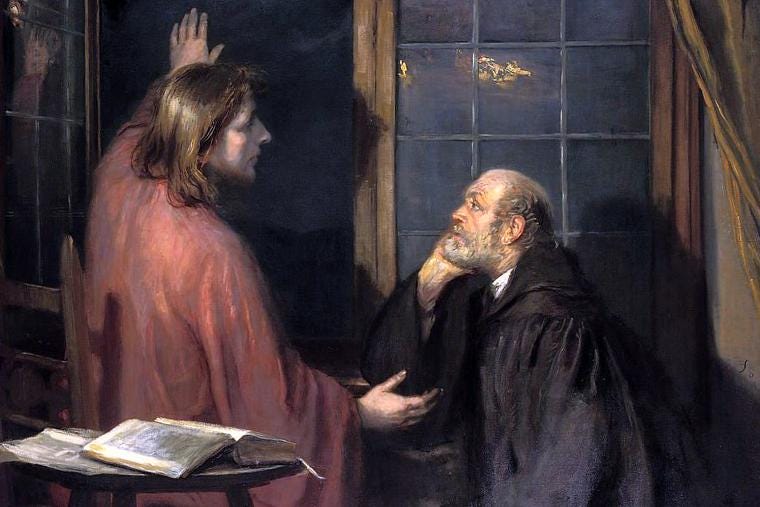
Last year, Pope Leo declared St. John Henry Newman the newest Doctor of the Church. Newman’s chosen motto was “Cor ad cor loquitur” (Heart speaks to heart). Truth, goodness, beauty -- we have always held that these things must be spoken from one heart to another. However, in our current age of Artificial Intelligence, I fear there is a great temptation to doubt the necessity of this belief.
Do certain truths demand cor ad cor loquitur, or can any such truth, goodness, and beauty be shared from machine to heart (or mind)?
I was confronted with this question again recently, when I read a post on X from well-known priest, Father Ian VanHeusen.
Father VanHeusen writes, “I have been spending the past week...developing my ideas and my ‘system’ using Ai. This has led the creation of 7 Ai books touching on everything from my theories on politics…[to] Prophecy, Visions and Miracles…[B]efore Ai, writing one of these 7 books would have taken 6 months to a year.”
Replying to his post on X, I asked father whether he was using AI merely as research tool, or to actually generate the books’ content. He answered that he was “debating that.”
Hoping to help father’s internal debate, I opined to him that AI is “great as a research tool, but philosophical/theological thoughts must be fundamentally the product of an immortal soul’s intellect/will/experience.” Father replied that I appeared more concerned with personal expression than objective truth, and that I seemed to be suggesting “that intellectual truth only exists in the mind,” but of course, as he notes, “truth can be expressed numerically by say a calculator.”
Father’s argument is that a proposition is true regardless of who or what declares that proposition. A calculator can show the truth that 2+2 = 4. An AI can output the words “God exists.” Both statements are true, and their truth or falsity doesn’t depend on the understanding (or total lack thereof) of the person/thing declaring them.
Father and I fundamentally agree on this point. When I made the statement that certain truths must be expressed by persons, I did not mean must in the sense that these truths “cannot exist without personal expression.” Rather, I mean must in the sense that certain truths “ought not be expressed by non-persons.”
This, then, is my actual position: that a truth is believed by another person and formulated by another person and shared with another person, isn’t unimportant. Indeed, it’s critically important. Someone may argue, if a proposition or statement is true, it doesn’t matter who or what represents that idea.
I believe this notion could not be further from the truth.
Truth, Algorithmically Optimized?
In his new encyclical addressing artificial intelligence, Magnifica Humanitas, Pope Leo notes that, “When efficiency becomes the ultimate measure of value, human beings are tempted to see themselves as a project to be optimized rather than as persons called to relationship and communion.” The idea that the end goal is the output of content, just so long as it is true, flirts with the idea that we can optimize expression of our beliefs.
The deepest truths about who we are as persons demand that they be expressed in charity, and with charity, and for charity. If we find this difficult, it’s only because it is. “It is not an easy thing to learn that new language which Christ has brought us,” Newman tells us.
To be clear, I am far from being anti-AI. Indeed, as a computer scientist, I use generative AI on a regular basis to aid me in computer programming. However, it seems to me there is a fundamental difference between prompting an AI to generate code and prompting an AI to generate professions of theological truth. In the former case, it is true that the content is the entire end. That is, whether AI generates a piece of code, or I write it myself, the content is purely functional. In the latter case, an expression of truth, goodness, and beauty demands something more than simply the statement of fact if it is to have the ability to move others to pursue the true, the good, and the beautiful.
We may train a parrot to recite the truths of the Nicene creed, but do we think that because it is true, this recitation would be proper and fitting to those truths? As Newman rightly observes, “That a thing is true is no reason that it should be said, but that it should be done, that it should be acted upon, that it should be made our own inwardly.”
Witness of Persons vs. Programs
We must not discount that there is a real concomitant truth, goodness, and beauty rightly found with the deepest professions of faith when these professions are witnessed and attested to by real persons. Indeed, many souls have come to the faith precisely by witnesses (martyrs) who testify to the truth. In some sense, we might say these martyrs did not present any new truths to the people who witnessed their deaths, but in a very real way, they certainly did. Their intention to present in charity, with the whole of their being, the truth about who they are and who Christ is allowed the truth to be shared in a way that is fitting and proper to it.
Truth matters. It matters so much it demands that we express it ourselves, in our own words, and in our souls, for the edification of other souls. I fear that we may be closing ourselves off from the grace and inspiration of the Holy Spirit by merely entering prompts into ChatGPT and copying and pasting the resultant output onto our social media accounts.
AI can output content that sounds Christian and images that look Christian, but that is not enough to claim that the work is Christian. The great 20th century philosopher Jacques Maritain explains:
[A]rt will be Christian, and will reveal in its beauty the interior reflection of the radiance of grace, only if it overflows from a heart suffused by grace…and because in the soul of the artist Christ is present through love. The quality of the work is here the reflection of the love from which it issues, and which moves the virtue of art instrumentally. Thus it is by reason of an intrinsic superelevation that art is Christian, and it is through love that this superelevation takes place.
Let us say then, as with art, true human authorship reveals in its truths the interior reflection of the radiance of grace when it overflows from a heart suffused by grace. If an AI accidentally first uttered that “You have made us for yourself, O Lord, and our heart is restless until it rests in you” we would certainly see the truth of such a phrase, but how can we fail to enter more deeply into that truth when we know that it was penned by a man who wandered for decades searching for rest in Him?
In theory, AI might opine about suffering, and even say things that are accidentally true, but these statements are merely a chimera of Christianity, because a machine cannot suffer. The truths of God’s love and suffering on the cross demand that they be witnessed by a soul who has united himself to the way of the cross. I see the superelevation of truth through love when I read the words of Bl. Franz Jägerstätter before he was beheaded by the Nazis, “We must go courageously on the way of suffering, whether we begin sooner or later. They may build many beautiful streets today, but they cannot change the way to heaven. This way will always remain rugged and rocky.”
In our own times, just a few weeks ago, I watched an interview with former senator Ben Sasse who, when asked whether he believed God has a plan replied, “Absolutely. There are no maverick molecules in the universe.” An AI might output similar words, but when a man who has been diagnosed with pancreatic cancer, racked with pain, face disfigured from treatment, and likely in his final days on this earth responds with all confidence, “there are no maverick molecules in the universe,” we are brought, inexorably, to the truth of the cross.
Yes, there are some truths on the way of the cross that can only be seen through the eyes of those who have walked it. But this road admits no shortcuts. It remains rugged and rocky. We will stumble upon this road, but this is only to follow in the footsteps of Our Lord. We must heed our Holy Father’s words and avoid seeing our limitations and weaknesses “as a project to be optimized.” After all, Christ has already assured us, “My grace is sufficient for you, for power is made perfect in weakness.”