

“Well, it’s Groundhog Day…again.” I know what you’re thinking. “Wasn’t it groundhog day yesterday?!”
Exactly.
It occurred to me that in the movie Groundhog Day, Phil performs every corporal and spiritual work of mercy. Yes, all fourteen of them! Don’t believe me? Well, ok, maybe the first one is a stretch.
To visit the imprisoned.
Phil visits the groundhog who is being held captive by the mayor of Punxsutawney. #JusticeForPhil
To feed the hungry
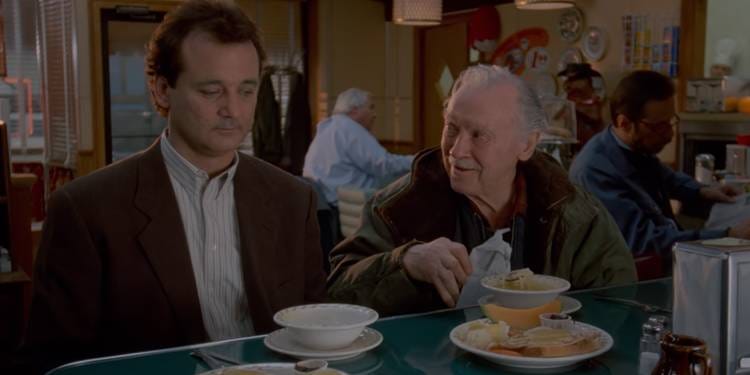
He feeds the homeless man. And he doesn’t just give him money for food, but sits with him and really notices his needs. When the old man is finishing up his bowl of soup, Phil says, “It gets hard down there at the bottom.” Perhaps there’s a lot more than soup being referred to in this comment.
To give drink to the thirsty.
He gives drink to the old man, but also to Larry and Rita.
Phil: “Who wants coffee? Get it while it’s hot!”
Rita: “Oh! Thanks, Phil!”
Phil: “Larry? Skim milk, two sugar.”
Even a simple generic gesture would be fulfilling the work of mercy, but he goes above and beyond and learned the exact way that his friends like their drinks. It is a great kindness to show someone that you have truly seen them.
To shelter the homeless.
He shelters the old man by taking him to the town diner. “Hello father. Let’s get you someplace warm.”
To visit the sick.
He visits with the old man, but “Dr. Connors” also visits Felix to fix his back. “He can even help around the house again!” “Well, I’m sorry to hear that Felix.”
To comfort the sorrowful.
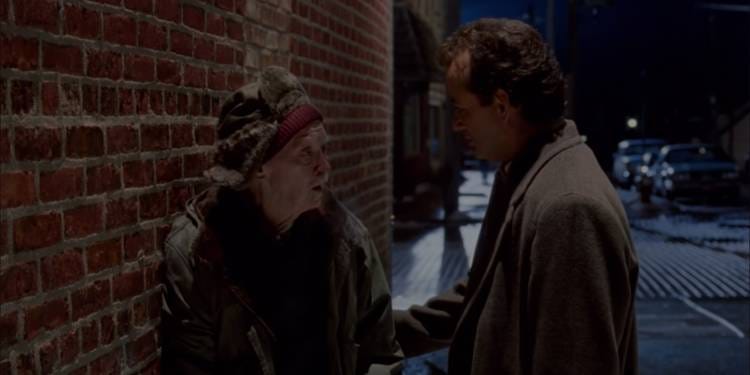
Phil stays with the old man, and he seems to die happy. Phil comforts him by calling him “Father,” “Pop,” and “Dad.” We aren’t told anything about the homeless man, but on his final day, Phil gives him the gift of reminding him who he is. Whether the old man had any children, we aren’t told. What we are shown, however, is that on his last day, he had one son who walked with him, sat with him, and in the end, as he took his final breath, knelt by him. No father could ask for more from a son.
To bury the dead / To clothe the naked
Nurse: “Sometimes people just die.”
Phil: “Not today.”
Despite his heroic efforts. Sometimes people do just die. Every night Phil tries to save the old man again, and every night he covers him with a blanket--clothes and buries him--when he can’t be saved. This is shown more clearly in a deleted scene (below)
where Phil pens the following note which he leaves on the old man for paramedics to find:
Every night, by cold bricks glow
I watch the shadow rising
from this old man in the snow
At 8:02 we let it go.
To admonish the sinner.
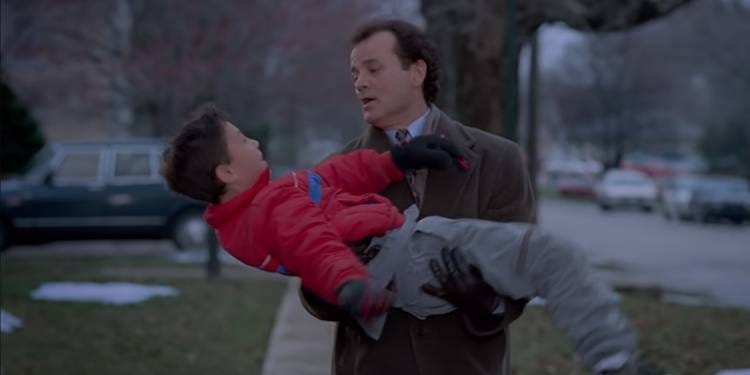
After Phil saves the little boy falling from the tree, the boy doesn’t thank him, but just runs away. Without Phil, the boy would have ended up in the hospital (we see him there in a different loop). In justice, he owes--at the least--a “Thank You” to Phil. Instead he simply runs away without saying a word. Phil admonishes him that this is terrible behavior. “What do you say, you little brat? You have never thanked me!”
To counsel the doubtful.
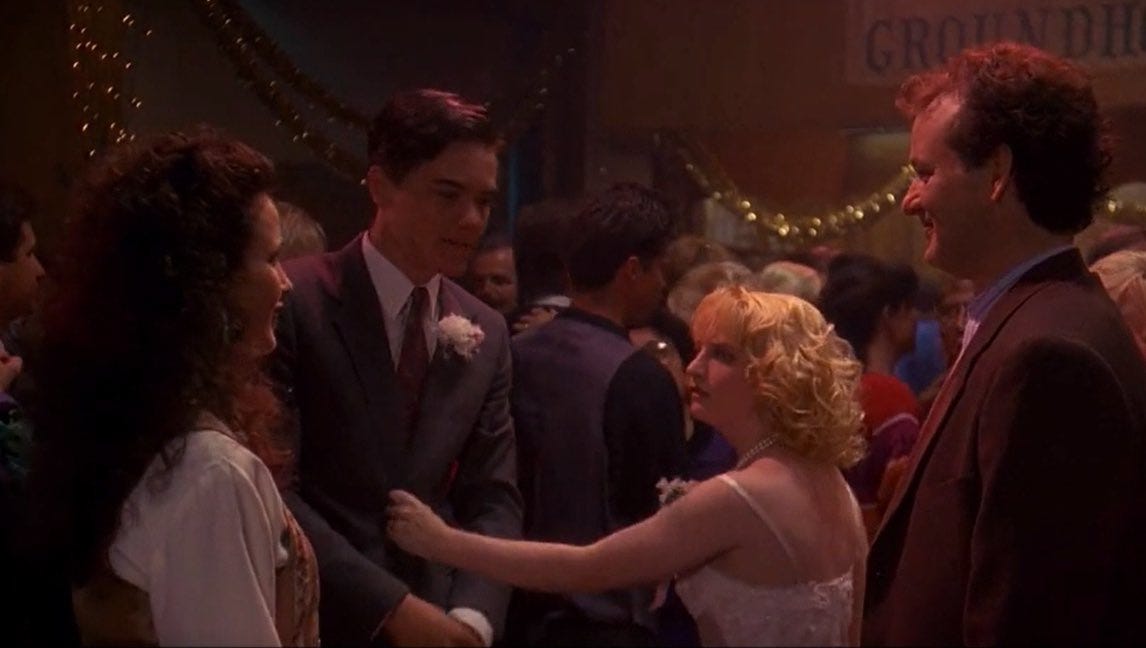
Phil counsels Fred and Debbie and alleviates Debbie’s doubt that she should be getting married.
Phil: “Hey, Fred, how was the wedding?
Fred: “Well, I just wanted to thank you for making Debbie go through with it and everything.”
Phil: “All I did was fan the flame of her passion for you, Fred.”
Debbie: “You are the best.”
To bear wrongs patiently / To forgive all injuries
After catching the boy (hurting his back in the process), and receiving no thanks, he still shouts after the boy, “I’ll see you tomorrow!” Every day he willingly undergoes pain and suffering that he knows will result in a lack of proper gratitude.
To instruct the ignorant.
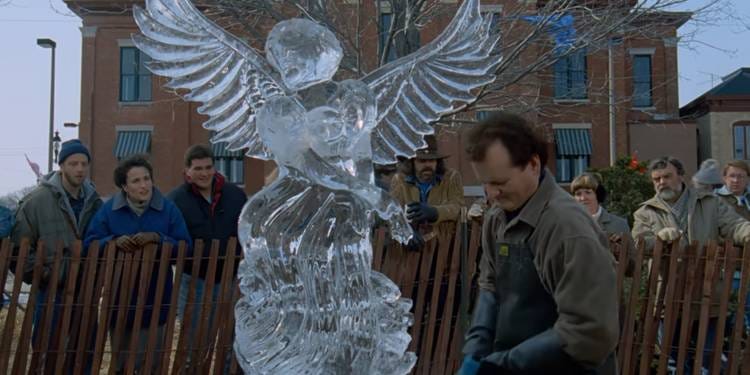
Far too many people fail to see the beauty of winter. Phil is not one of those people. Snow and ice are marvels, and Phil knows it. The town gathers around to watch him create a breathtaking ice sculpture. For Rita, he creates a sculpture of her face from snow.
Rita: “It’s amazing. It’s beautiful. How did you do that?”
Phil: “I know your face so well, I could have done it with my eyes closed.”
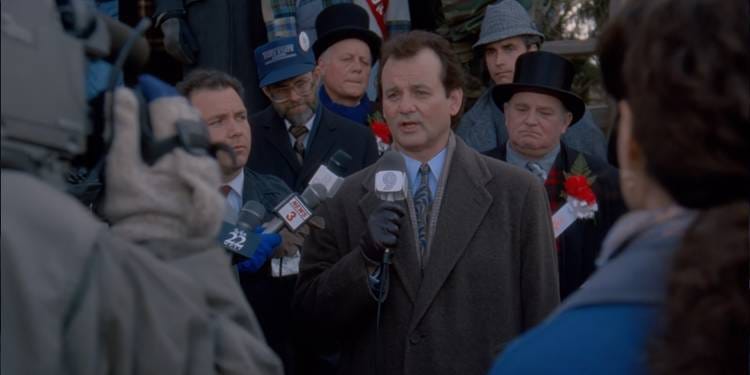
To those who fail to see the beauty of all God’s seasons, Phil tells them, “When Chekhov saw the long winter, he saw a winter bleak and dark and bereft of hope. Yet we know that winter is just another step in the cycle of life. But standing here among the people of Punxsutawney and basking in the warmth of their hearths and hearts, I couldn’t imagine a better fate than a long and lustrous winter.”
To pray for the living and the dead.
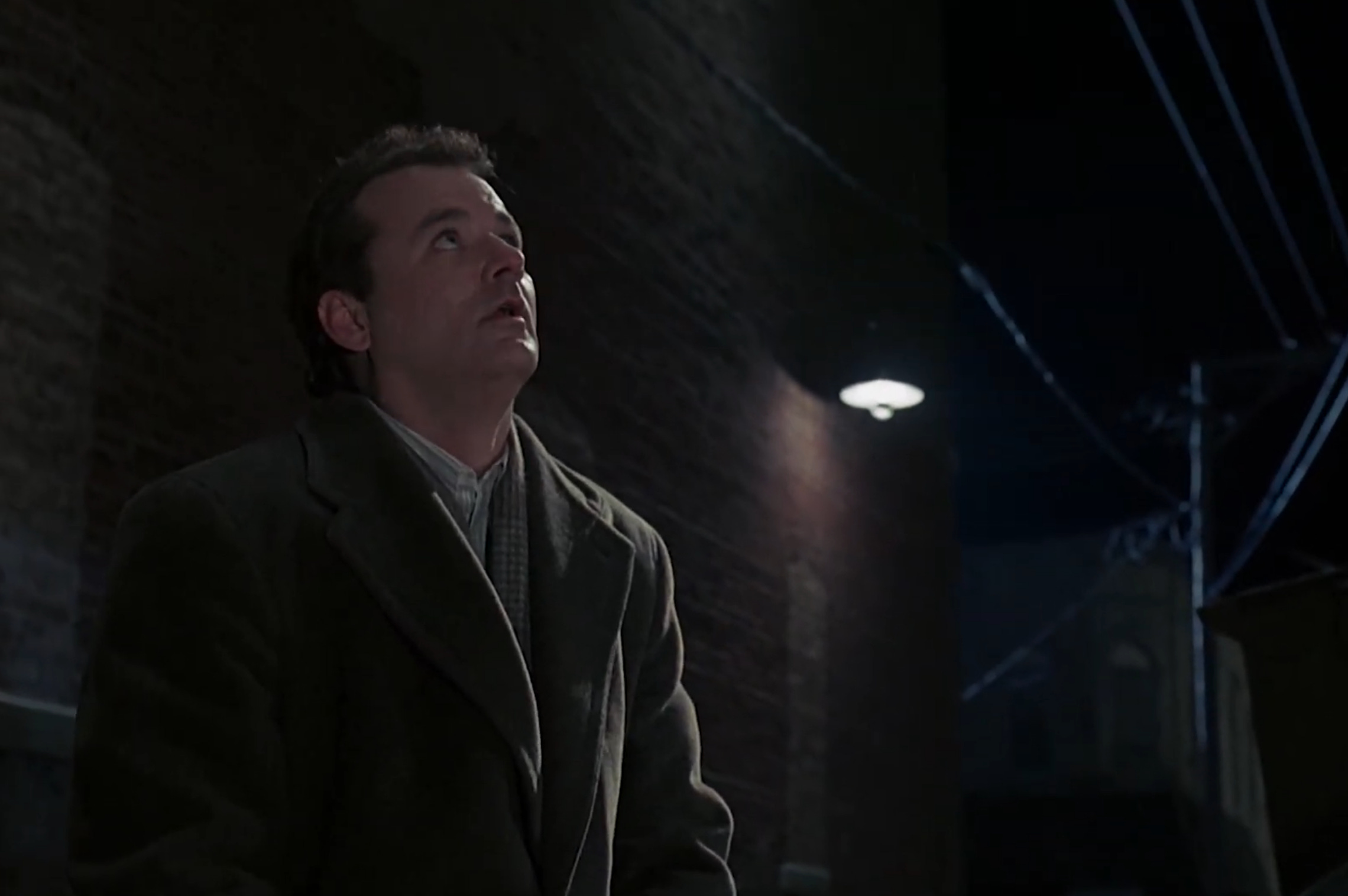
Of course, Phil believes in God. “I’m a God, I’m not THE God.” When the old man dies, we see Phil look up to heaven. I think this is pretty clearly meant to be a prayer for the old man both now that he has died, and almost certainly a prayer for him tomorrow, and that Phil might somehow be allowed to save him. It’s the most heartbreaking scene in the movie.
Mother Teresa once said, “God doesn’t ask that we succeed in everything, but that we are faithful. However beautiful our work may be, let us not become attached to it. Always remain prepared to give it up, without losing your peace.”
Phil is faithful, night after night, knowing full well that, barring a miracle, he won’t succeed. That never stops him from being faithful, “every night by cold bricks glow.” And at 8:02, every night, though his work is beautiful, “we let it go.”
The lesson.
The movie makes clear that the reason Phil finally moves on is precisely because, in one day, he manages to fulfill the charge of an old quote that says, “I expect to pass through this world but once. Any good, therefore, that I can do or any kindness I can show to any fellow creature, let me do it now. Let me not defer or neglect it for I shall not pass this way again.”
In a sense, the movie flips this idea on its head and makes the demand of Phil that he will pass this way again, until and unless, any good or kindness is shown to any fellow creature.
The lesson is that we are to be faithful because, each day, there is so much good that we can do. Did we perform every kindness we could yesterday? No? Well, good news: we’ve been given another chance.
Today.
And tomorrow.
God bless you & yours.
Glory be to the Father, Son and Holy Spirit. As it was in the Beginning, Now, and Ever shall be. Amen.
I loved this essay so very much. Thank you.